When the ArriveCan scandal broke, the Government of Canada promised to clean up its reliance on outside IT middlemen — the staffing firms that won contracts and then subcontracted the actual work. Two years on, did anything actually change?
We went to the government's own proactive contract disclosure and tracked the firms at the centre of the affair, year by year. The short version: the cut was real, it was fast, and it was targeted — the scandal-tainted middlemen were dropped, while the big professional-services firms kept right on growing.
The firms at the centre of ArriveCan were dropped — hard#
Start with Coradix, one of the staffing firms most associated with the affair. Its federal business had been climbing for years, peaking at 341 contracts worth roughly $367 million in 2023-24 — its biggest year ever. The next year it fell off a cliff: 13 contracts, about $14 million. And in 2025-26 its disclosed totals turn negative — roughly −$14 million — which means the government wasn't just declining to award new work, it was actively cancelling and clawing back existing contracts.
Dalian, Coradix's frequent joint-venture partner, followed the same arc: about $141 million in 2022-23 down to under $1 million by 2024-25, with nearly half of its remaining 2024-25 records showing cancellations rather than new awards.
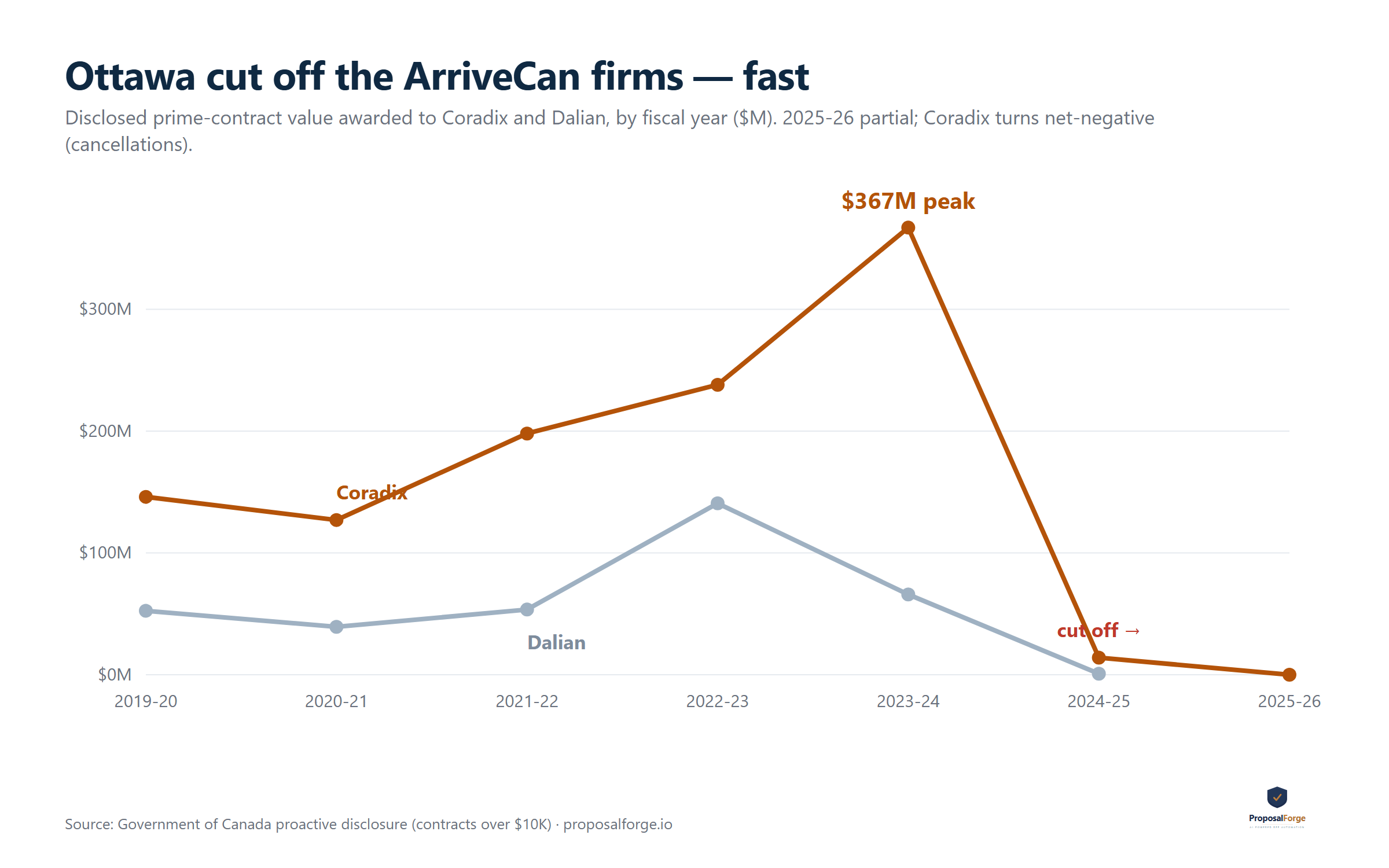 Federal contract value awarded to Coradix and Dalian by fiscal year, showing the spike to 2023-24 and the sharp drop after.
GC Strategies — the two-person firm that became the scandal's public face — trails to nothing after 2023-24, consistent with its suspension from federal contracting. (A note on GC Strategies specifically: because much of its work flowed through subcontracts and joint ventures, and disclosure only captures the prime contract holder, the firm's true federal footprint is larger than any single name-matched total. We treat its disclosed dollars as a floor and lead with the trend, not a headline figure.)
This isn't a story about disclosure lag or incomplete data. The collapse coincides with actual cancellation records in the data, and the most recent full fiscal year is reported at normal volume. The firms were cut off.
But the Big Four kept growing#
Here's the part that complicates the easy narrative. Over the same period, the large professional-services firms didn't shrink at all. By contract count — the most reliable measure — Deloitte holds 1,127 federal contracts and PwC 1,013, followed by KPMG, EY and Accenture in the hundreds. The dollars there are large, but they're concentrated in multi-year IT-services work, and they kept climbing.
In other words: Ottawa dropped the tainted middlemen. It did not wean itself off consultants.
"Consultant" means two completely different businesses#
One nuance gets lost in almost every debate about consultant spending. The word covers two very different business models, and the contract data makes the split obvious.
McKinsey and BCG do a handful of large engagements — about 16 and 14 federal contracts respectively, but with median contract values north of $1.3 million. That's classic boardroom strategy work. Deloitte and PwC do the opposite: thousands of smaller contracts at a median around $280,000 — the IT-staffing and professional-services model.
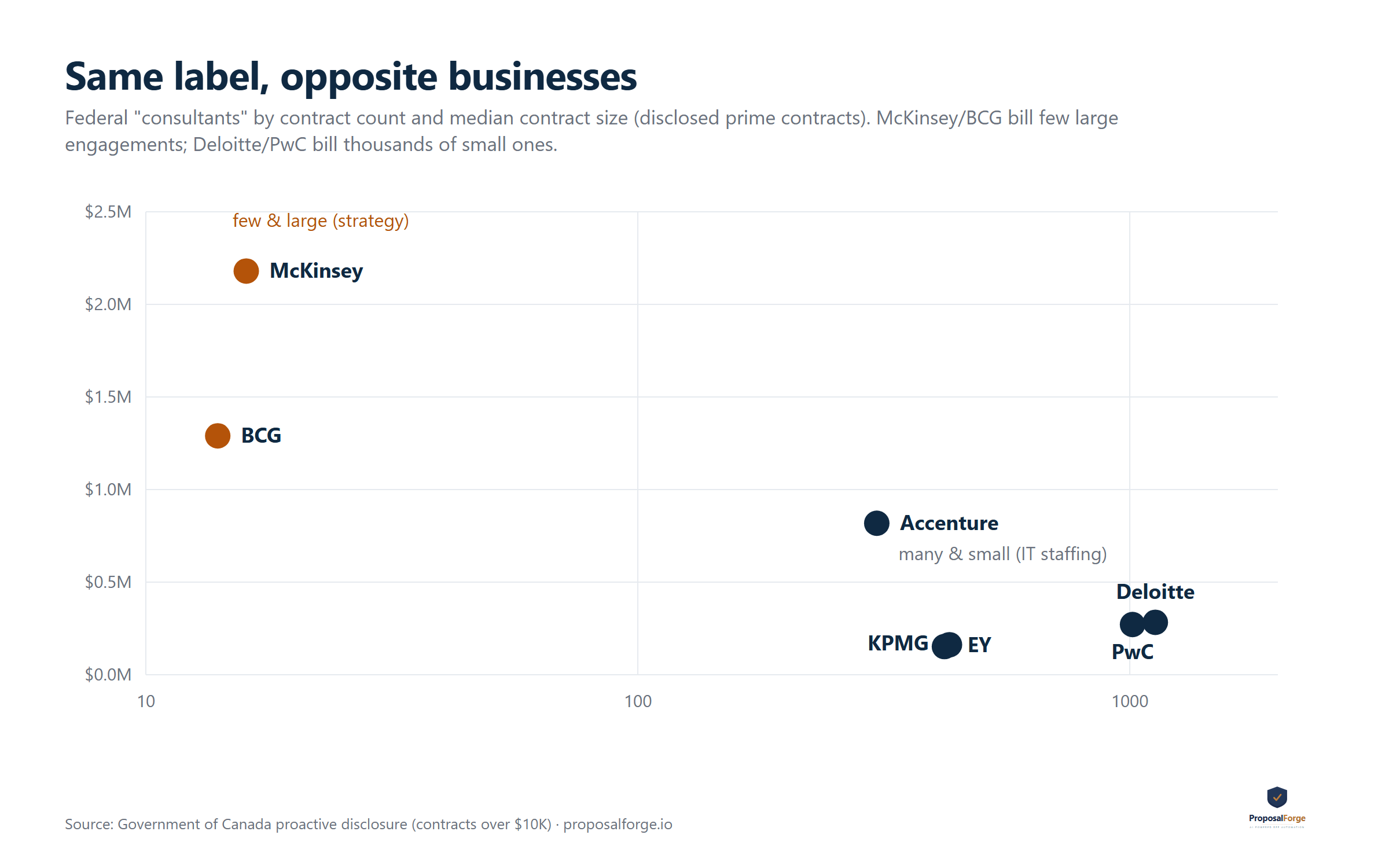 Federal consultants plotted by contract count and median contract size — McKinsey and BCG do few large engagements while Deloitte and PwC do thousands of small ones.
When a headline says "the government spent $X on consultants," it's usually blending these two together. They're not the same thing, and the policy questions they raise are different.
How we measured this — and what it doesn't cover#
These figures come from the Government of Canada's proactive contract disclosure (CanadaBuys and open.canada.ca), consolidated into one searchable place. A few limits are worth stating plainly, because they change how you should read the numbers:
- Disclosed contracts over $10,000 only. Contracts below that threshold aren't published, so this is not "all" federal contracting.
- Prime contracts only. Subcontracts and joint-venture work are attributed to the prime contractor, so a firm's true federal footprint can be larger than what's matched to its name. (This is exactly why we don't headline a single dollar total for GC Strategies.)
- Counts and medians over raw dollar sums. A handful of very large multi-year IT contracts can dominate any naive total, so we lead with contract counts and median size, which are robust. Year-level dollar figures are the disclosed value of contracts awarded that year — not annual cash paid.
- Firms are matched by name, which can miss variant legal names; recent fiscal years are well-attributed, and negative recent-year totals reflect genuine cancellations.
You can check any of it yourself in the underlying data — every contract record, by vendor and department, is searchable in our federal IT-spending and contracts explorers.
The takeaway#
The accountability story here is genuinely positive and genuinely limited. Faced with a scandal, the government moved quickly to cut off the specific firms involved — the data shows that clearly. But the broader reliance on outside professional services didn't budge. Whether that's a problem depends on which kind of "consultant" you're worried about.